The showcase highlights our work using Nimblemind’s Multi-Agent System (nMAS) to help predict pain spikes in patients with opioid use disorder by bringing together EMR, patient survey, and wearable data.
Jul 7, 2026
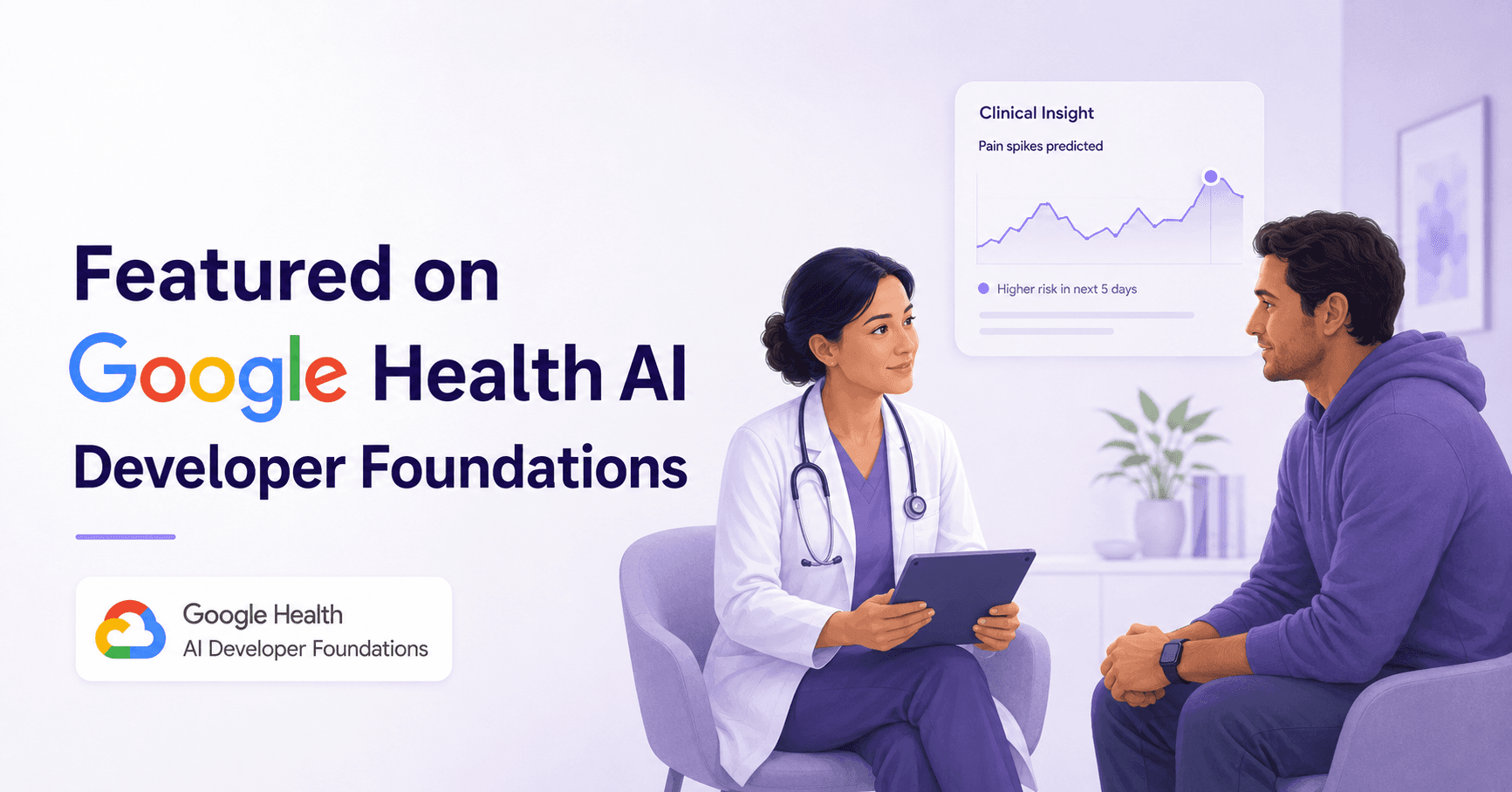
Healthcare AI depends on more than powerful models. It depends on reliable clinical data infrastructure.
Nimblemind’s work was recently featured on Google’s Health AI Developer Foundations site, highlighting how our team is using MedGemma and Nimblemind’s multi-agent system (nMAS) to support pain spike prediction in patients with opioid use disorder.
The featured work builds on Nimblemind’s collaboration with the APT Foundation, where our team brought together wearable data, patient-reported surveys, medication data, and clinical records from patients living with chronic pain and opioid use disorder. These patients often experience changes in pain, stress, sleep, cravings, and activity that are difficult to capture during periodic clinical visits alone. By organizing these multimodal signals into a structured dataset, Nimblemind helped create a foundation for predicting future pain spikes and surfacing clinically useful insights.
Google’s feature focuses on the infrastructure underneath that work: how fragmented clinical data can be ingested, de-identified, structured, interpreted, and routed through a reliable AI pipeline. Nimblemind’s multi-agent system coordinates specialized agents across the clinical data workflow, turning raw inputs from EMRs, patient surveys, and wearable devices into structured, patient-specific signals.
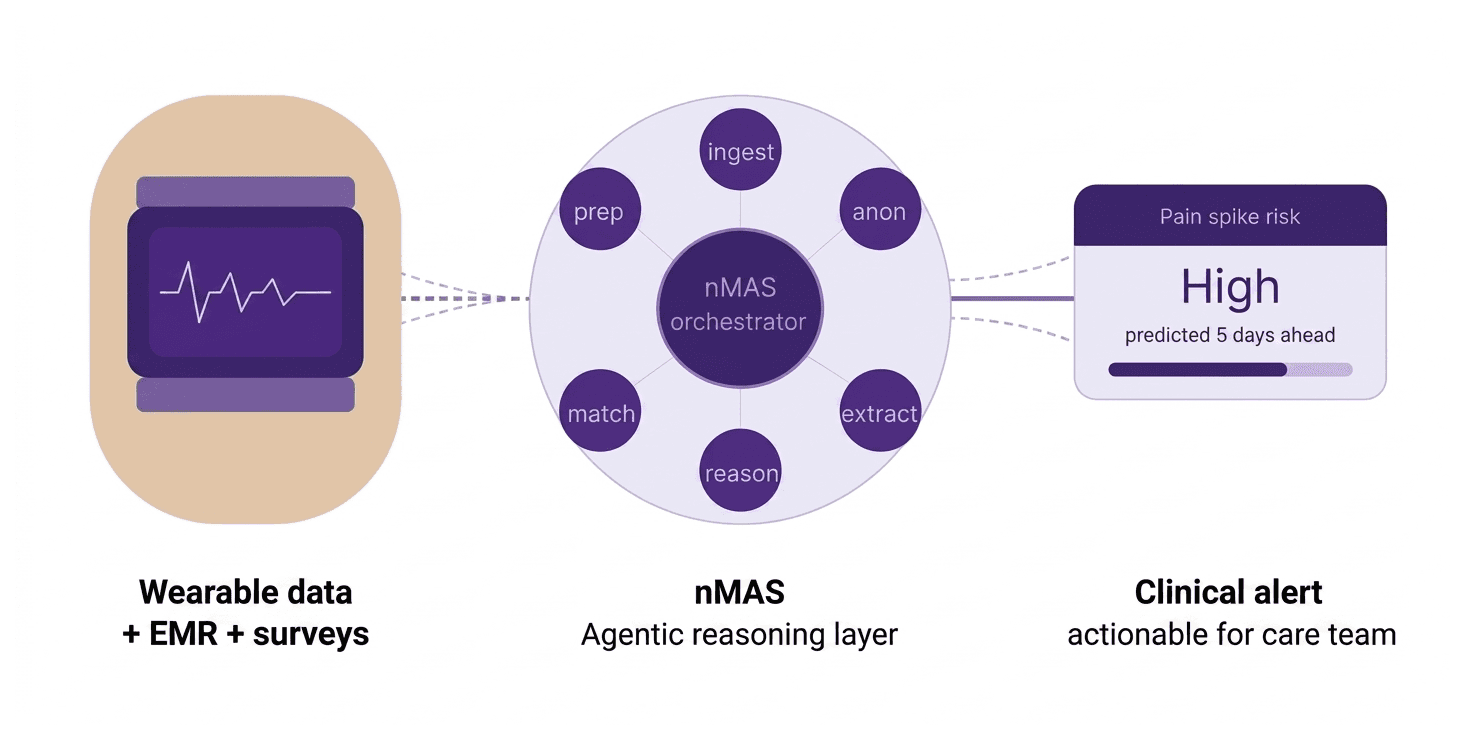
That structured representation is what makes downstream AI more useful. Instead of asking a model to reason over disconnected files, notes, or measurements, the system first creates a reliable foundation. That foundation preserves where the data came from, what it means clinically, and how it relates to the patient over time.
This is what we call the Chart Truth Layer: the structured, source-traceable representation of a patient’s clinical reality. It preserves the context buried across notes, records, surveys, labs, wearables, imaging, and other data sources so downstream AI systems are not reasoning over disconnected fragments.
In the featured work, this infrastructure helped support pain spike prediction up to five days in advance. More broadly, it reflects the problem Nimblemind is focused on solving across healthcare: before AI can support research, operations, or care delivery, the underlying data needs to be usable, traceable, and grounded in clinical context.
We’re grateful to see this work recognized by Google Health AI Developer Foundations and excited to keep building the infrastructure that helps healthcare organizations turn messy clinical data into reliable, AI-ready intelligence.
Read the Google feature here →
