Applying an evidence-linked multi-agent workflow to pathology review with SingHealth
Jun 23, 2026

Persistent Helicobacter pylori (H. pylori) infection is associated with chronic gastritis, peptic ulcer disease, and an increased risk of gastric cancer. In pathology workflows like those at SingHealth, identifying biopsy-confirmed cases for treatment follow-up, clinical audits, and research typically requires reviewing pathology reports individually to determine which patients meet the case definition. While often treated as a simple lookup task, it is rarely that straightforward. The need to manually review large volumes of reports and interpret relevant clinical details makes this process time-consuming and resource-intensive, highlighting the need for approaches that can efficiently identify relevant findings while preserving evidence for clinical verification.
Why Pathology Case-Finding Is Hard to Get Right
Pathology reports capture observations in free text rather than as structured positive or negative results. Whether a finding is confirmed, excluded, or simply not mentioned often depends on subtle wording, and the same finding may be described differently across pathologists and institutions. As a result, keyword searches cannot reliably distinguish between positive and negative findings because both frequently share the same vocabulary.
The challenge is not simply searching report text more effectively. It is determining, field by field, what level of reasoning an extraction requires and applying that reasoning consistently.
This project focused on a pathology workflow within SingHealth, Singapore’s largest public healthcare cluster. The evaluation used de-identified gastric biopsy pathology reports from Singapore General Hospital’s Department of Anatomical Pathology, where case-finding for H. pylori can support treatment review, eradication follow-up, clinical audit, research cohort assembly, and quality-improvement workflows.
A Structured Workflow for Evidence-Linked Extraction
We applied the Nimblemind Multi-Agent System (nMAS) to a sample of de-identified gastric biopsy reports from Singapore General hospital, working with senior pathologists to target four binary fields:
Gastric/stomach biopsy
Biopsy status
H. pylori positivity
H. pylori-associated gastritis
Across 216 feature-case evaluations, nMAS correctly extracted 213 values, achieving an overall accuracy of 98.61%, without additional finetuning on client data. Notably, this performance was achieved without ever being trained on this hospital’s specific reports beforehand.
Field | Accuracy |
Gastric/stomach biopsy | 100.00% |
Biopsy status | 100.00% |
H. pylori positivity | 98.15% |
H. pylori-associated gastritis | 96.30% |
Overall | 98.61% |
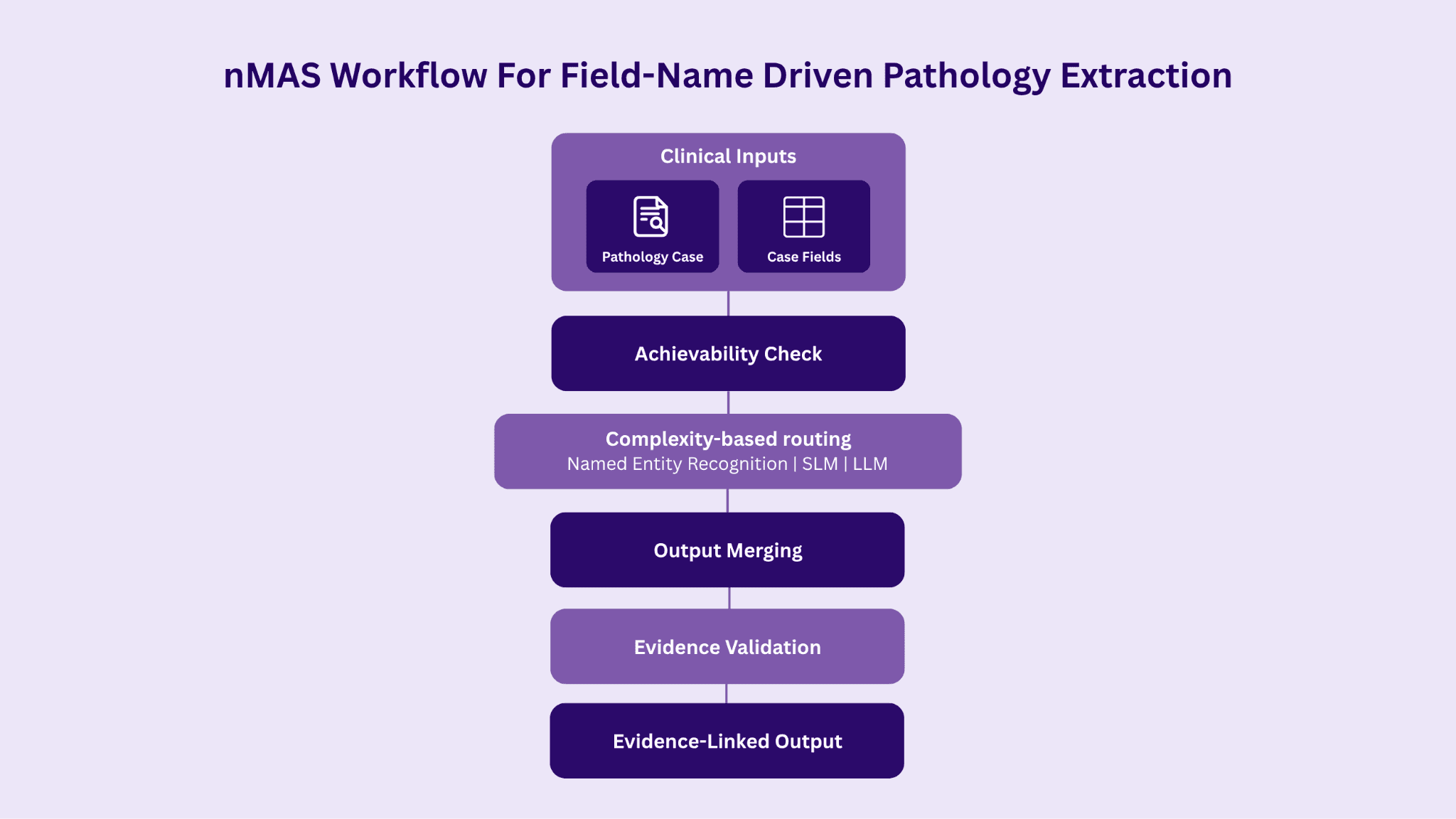
Rather than applying the same extraction method to every field, nMAS routes each request through a structured workflow:
Achievability check – Verifies that the report contains usable pathology information and that the target field is supported by the extraction schema.
Complexity-based routing – Routes each field to the appropriate extraction pathway based on its requirements.
Output merging – Consolidates results from multiple extraction pathways into a single schema-consistent report-level output.
Evidence validation – Verifies every extracted value against the source text.
This distinction is important because different fields require different forms of reasoning. Specimen eligibility is often supported by explicit report elements, whereas disease-related findings require interpretation of diagnostic context and assertion status.
Why Auditability Matters
Common approaches to pathology extraction involve trade-offs. Rule-based systems require ongoing maintenance, supervised models depend on annotated training data, and general-purpose language models can be difficult to audit.
nMAS combines flexible extraction with traceability. Field-level definitions establish explicit extraction criteria, while evidence linking associates each output with the source text that supports it. Reviewers can therefore evaluate results against documented evidence rather than relying on model outputs alone.
What This Means in Practice
At an illustrative five minutes per report, manually screening 1,000 pathology reports requires approximately 83 staff-hours. By contrast, an evidence-linked workflow that returns extracted findings with supporting citations can reduce review to rapid verification, potentially lowering effort to little more than an hour for the same workload, resulting in a 98% reduction in review time.
That difference represents approximately 82 staff-hours recovered per review cycle. Depending on staffing mix and local salary costs, the associated staff-time value can range from several thousand dollars to more than USD8,000 for a single 1,000-report review exercise.
While actual savings depend on report complexity, workflow design, and review requirements, the operational implication is straightforward: the bottleneck shifts from finding information to acting on it. Clinical teams spend less time searching reports and more time performing the work that requires human judgment.
How This Fits Into Nimblemind's Approach
H. pylori case-finding reflects a broader challenge in clinical data work: the information needed for a decision is often already present in the record, but retrieving it reliably from unstructured documentation remains difficult.
In this SingHealth pathology project, gastric biopsy review was used as a focused example of that challenge. Identifying biopsy-confirmed H. pylori cases from collections of pathology reports can consume substantial clinical and research effort before downstream work can begin. This same challenge applies to other recurring case-finding needs too, such as identifying cancer biomarker results (HER2, PD-L1) or surgical margin status across pathology reports.
The results of this study suggest that an evidence-linked workflow can help address that burden. By converting pathology reports into structured, reviewable outputs and linking each finding to supporting source text, nMAS enables faster verification while preserving auditability.
This reflects Nimblemind’s broader approach to clinical AI. Rather than building a new pipeline for every dataset or use case, the goal is reusable infrastructure: field definitions, routing logic, and evidence validation that hold up as the schema expands and the report volume grows. As this approach expands to larger datasets and additional pathology workflows, the objective remains the same: structured outputs that are clinically meaningful, transparent, and directly verifiable against the underlying record.
