Scaling tumor board preparation with clinician informed data extraction
Sep 11, 2026

Cancer treatment decisions are guided by tumor board meetings, where oncologists, surgeons, radiologists, and pathologists convene to review a patient's case. These are high-stakes decisions, and making the right call depends on having accurate, complete information ready before the meeting starts, covering tumor staging, biomarker results, and treatment history. Just as important, clinicians need to be able to trace that information back to its source, since the ability to verify where a value came from is critical for clinical validation and decision-making. If a detail is missing, incorrect, or impossible to verify, clinicians may be working from an incomplete or unreliable picture of the case, and the time spent resolving that uncertainty can add to delays before treatment begins. The risks here are measurable. A large meta-analysis covering over 1.2 million patients across seven cancers found that every four-week delay in starting treatment was linked to a 6 to 13% higher mortality risk, regardless of whether the treatment was surgery, systemic therapy, or radiotherapy.
In oncology, this presents a particular challenge as each cancer type is governed by its own staging systems and biomarker panels, and the relevant details are distributed across pathology reports, radiology notes, and clinical records written in free text. This information is often put together by hand, which takes time and leaves room for error, and becomes harder to manage well as patient volume grows.
OncoLens, a leader in AI driven automation of oncology related tumor boards, analytics, and workflow solutions, and Nimblemind, recently partnered to assess the utilization of Nimblemind’s proprietary Multi-Agent System, nMAS, against other traditional AI driven data extraction models, working towards maximizing the accuracy of data extracted.
OncoLens contributed the patient document sets and clinician-reviewed answer keys for multi-feature extraction. Rather than passing every document to every model, OncoLens applied AI-driven document selection: each document was scored and ranked on clinical-relevance and evidence signals, and only the top candidates were sent to extraction. Across a large document volume, this kept the study affordable at production scale and gave the extraction models cleaner, higher-yield inputs. With clinician-reviewed answer keys as the benchmark, the accuracy figures reflect clinical ground truth, not model self-assessment.
How nMAS Handles Adaptability and Trust
Most automated approaches to feature extraction run into two problems. Some approaches rely on task-specific training or fixed schemas, which makes them hard to adapt as cancer types, report formats, or institutional needs change. Other approaches use language models that can produce values that sound correct but aren't backed by the source document, a risk that's especially serious in clinical settings.
Feature | Descriptor | Feature-Specific Guidance |
Biomarker Name | Biomarker, receptor, or IHC marker names stated in the cancer-specific panel. | Return marker names only, not result words. Include negative markers when the panel explicitly lists them, because absence of positivity is still a reported biomarker result. |
Specimen label | Specimen part label associated with the reviewed specimen item. Type: string. Example: G. | Return only labels that directly identify the target specimen item, not every part label visible in the report. Evidence must include the specimen letter and local specimen description. |
Table 1: Representative examples of clinical-defined guidance used in the clinician-informed in-context learning framework
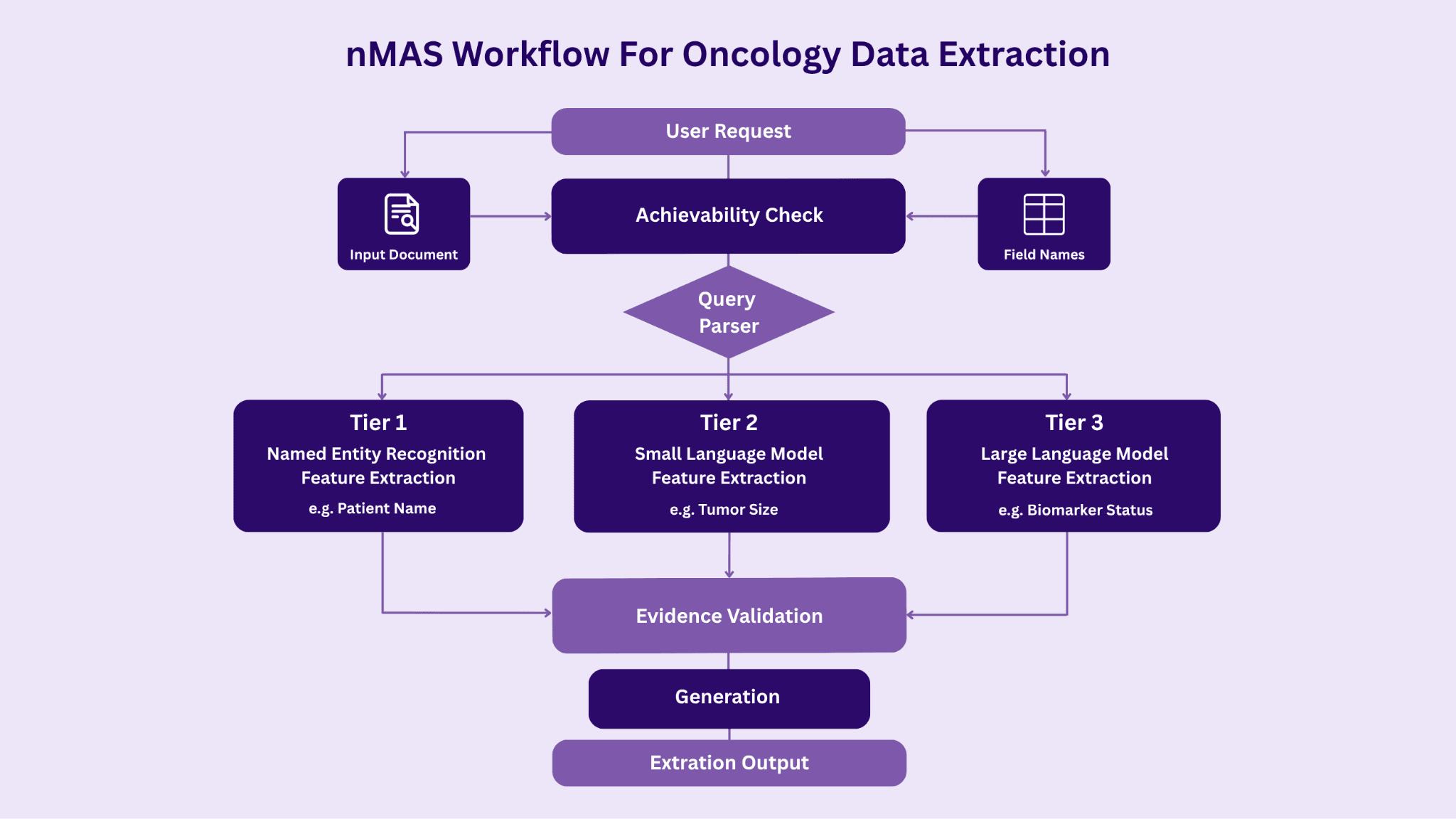
Nimblemind's Multi-Agent System (nMAS), addressed both concerns using a clinician-informed in-context learning framework, paired with a verbatim validation agent. The in-context learning framework lets the system learn from examples that OncoLens’ clinicians design, rather than being trained separately for every new feature, as shown in Table 1. For more complex extraction needs, the system also draws on models fine-tuned on Nimblemind's own proprietary data, adding a layer of domain-specific training behind the scenes. This lets the system extract relevant attributes across different report types and cancer types without retraining. The verbatim validation agent checks every extracted value against the source text before it's accepted, so the system only outputs information it can point back to directly.
Built Around What Clinicians Need Most
The clinician examples also come tagged with an importance rank for each feature, set by OncoLens’ clinicians, which is used both to guide the model and to weigh results more heavily for higher-priority features. Rank 1 covers features that most directly affect treatment decisions, like disease status and treatment line, while Rank 2 and 3 cover supporting details like imaging context and recurrence flags.
This matters in practice because oncology data is rarely a single, clean value. A biomarker panel, for example, can list ten or more individual markers, such as Estrogen Receptor (ER), Progesterone Receptor (PR), and p53, in one block of text, and the system needs to identify each one separately rather than treating the panel as one result. The same goes for staging details like tumor size or nodal involvement, which are often buried in descriptive sentences rather than stated as standalone fields. Getting these details right means clinicians can rely on the structured data directly, without needing to go back and reread the original report.
Performance and Trust: Beyond the Numbers
We evaluated nMAS on de-identified oncology documents, alongside a baseline built around UMA, or Universal Abstraction. The baseline extracts one attribute at a time from a document, asking the model to find a single value at each step. nMAS reached an accuracy score of 94.37%, with strong results holding up across every priority rank, as shown in Table 2.
Metric | Rank 1 | Rank 2 | Rank 3 | Overall |
Accuracy | 97.02% | 88.14% | 96.35% | 94.37% |
Table 2: nMAS extraction accuracy by clinician-ranked feature importance
The baseline's one-attribute approach falls short on many oncology fields, particularly when a value involves repeated specimens, biomarker panels with several individual results, or details embedded inside longer descriptive sentences rather than stated plainly. The gap comes down to what each system does with a document before extracting a value. While the baseline works attribute by attribute, nMAS combines routing, section construction, hybrid extraction, normalization, and evidence validation into a single pipeline. This fuller structure is what allows nMAS to outperform one-attribute extraction on the complex, multi-part fields that oncology documents often contain.
The performance gap matters, but for clinicians, the bigger benefit is being able to validate the work. nMAS addresses this through a Verbatim Validation Agent, which checks that every extracted value is directly supported by text from the original document. This means a clinician can trace each value back to its source and confirm it quickly.
Scaling Tumor Board Intelligence
This work reflects Nimblemind's approach to clinical AI, which emphasizes transparency and clinician-informed design. In oncology, this enables the conversion of complex clinical documentation into structured, review-ready summaries that support efficient tumor board preparation, the workflows OncoLens delivers to cancer programs today, while maintaining traceability to source evidence.
As oncology data continue to increase in volume and complexity, scalable abstraction systems must balance accuracy, adaptability, and auditability. This study demonstrates that agent-based architectures can support tumor board preparation at scale and may extend to broader oncology data abstraction and decision-support applications.
